
About Nassau County Court Clerks
Outside New York City, court record-keeping in Nassau is shared. The elected Nassau County Clerk is Clerk of the Supreme and County Courts, so those civil and felony files run through that office. Every other trial court has its own clerk, who keeps the records for that court alone. That split is why a record seeker must know the court before knowing the counter.
The main court clerks are at District Court in Hempstead, Family Court and Matrimonial at the County Seat Drive complex, Surrogate's Court at Old Country Road, and the city courts in Long Beach and Glen Cove. Town and village justice courts keep their own local records. Each clerk handles filing, copies, certificates, and counter questions for its court.
What Each Nassau Court Clerk Holds
The fastest way to find a record is to match it to the court that made it. The list below pairs each Nassau court clerk with the records it keeps.
- County Clerk - Supreme and County Court civil and criminal files, land records, and judgments. See the Nassau County Clerk page.
- District Court Clerk - Misdemeanors, violations, small claims, landlord-tenant, and traffic-crime files in Hempstead.
- Surrogate's Court Clerk - Wills, probate, administration, and estate files. See the Surrogate's Court page.
- Family Court Clerk - Custody, support, and family matters, with access restricted under Family Court Act § 166.
- City Court Clerks - Local civil, criminal, and traffic matters in Long Beach and Glen Cove.
For Supreme and County Court records, the County Clerk page covers fees and certified copies. This page focuses on the other court clerks.
Nassau Court Clerk Contacts
Each court has a main line and, for the larger courts, a chief clerk's office. The table below lists the working numbers for the main Nassau trial courts and city courts.
| Court | Address | Phone |
|---|---|---|
| District Court | 99 Main Street, Hempstead | 516-493-4200; Chief Clerk 516-493-4159 |
| County Court | 262 Old Country Road, Mineola | 516-493-3710 |
| Surrogate's Court | 262 Old Country Road, Mineola | 516-493-3800; Chief Clerk 516-493-3805 |
| Family Court | 101 County Seat Drive, Mineola | 516-493-4000 |
| Long Beach City Court | One West Chester Street, Long Beach | 516-442-8544 |
| Glen Cove City Court | 13 Glen Street, Glen Cove | 516-403-2440 |
Family Court and Matrimonial moved to 101 County Seat Drive in June 2025, so older addresses for those courts are out of date.
How to Request a Record from a Court Clerk
The steps are similar across courts, but the contact changes with the court. A certificate of disposition, the court-certified outcome of a criminal case, is one of the most common requests, and District Court issues it for matters it handled.
- Identify the court that handled the case, then call its clerk from the table above.
- Have the case or docket number, the party name, and the year ready.
- Ask for the document by name, such as a certified copy or a certificate of disposition.
- Confirm the fee and the accepted payment method before you visit or mail the request.
For criminal cases with a future date, the WebCriminal case identifier search can confirm a case number first. The image below opens that form.
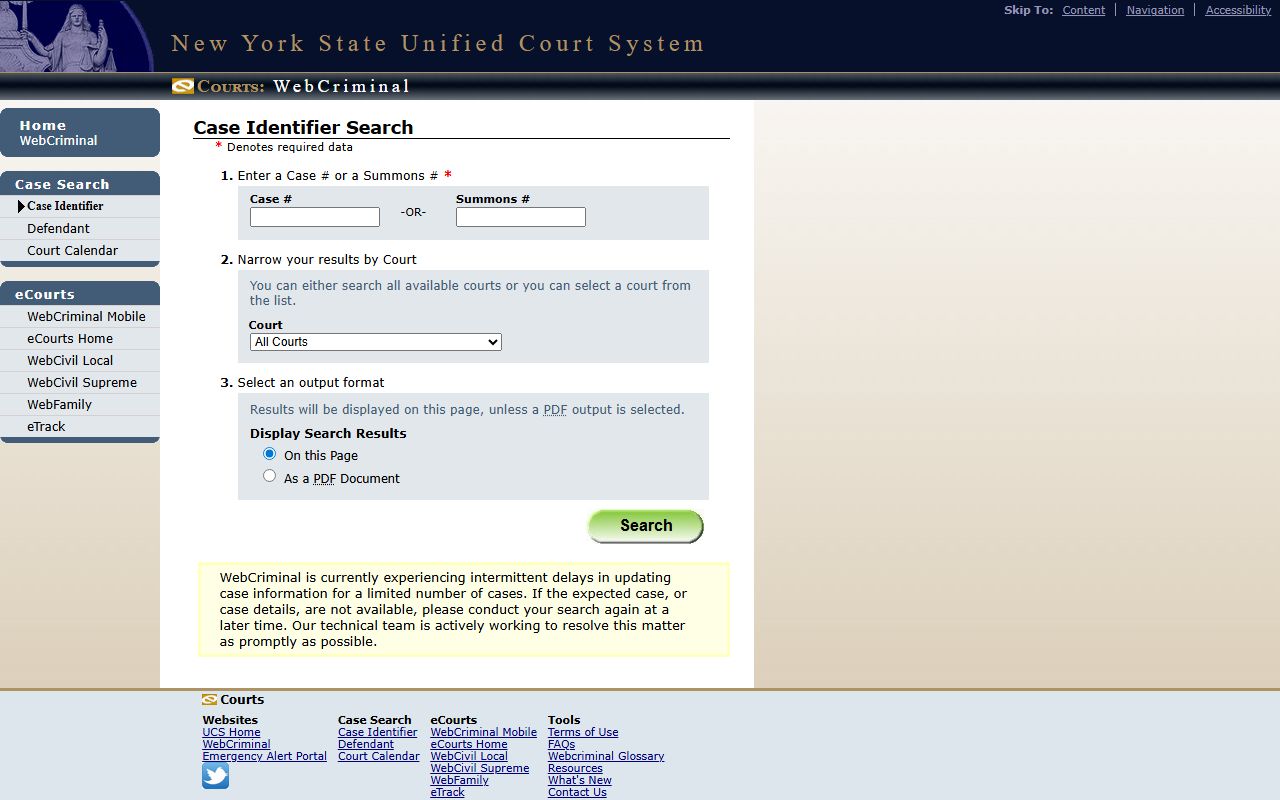
Knowing the case number speeds a certificate request, since the clerk can pull the exact file without a name search.
District Court Department Directory
District Court in Hempstead is the busiest lower court, and it splits its work across many departments, each with its own line. The table below lists the department phone directory so a caller can reach the right desk the first time.
| Department | Phone |
|---|---|
| Main Information Line | 516-493-4200 |
| Chief Clerk's Office | 516-493-4162 |
| Civil Department | 516-493-4113 |
| Criminal North | 516-493-4045 |
| Criminal South | 516-493-4201 |
| Landlord / Tenant | 516-493-4138 |
| Small Claims | 516-493-4125 |
| Interpreters | 516-493-4230 |
| Treatment Court | 516-493-4145 |
District Court has separate Criminal North and Criminal South lines, a detail that trips up many callers. Adjournment requests in District Court must be in writing and will not be taken by phone.
District Court Fees and Certificates
The trial-court clerks charge their own fees, separate from the County Clerk's legal schedule. The most asked-for criminal document is the certificate of disposition, which District Court issues for matters it handled. It is the court-certified outcome of a charge, and many agencies require it.
| Document | Fee |
|---|---|
| Certificate of Disposition (District Court criminal) | $5 |
Other District Court fees cover civil filings, small claims, and copies. Because these change and vary by case type, confirm the current amount with the relevant department before you file or request a copy. Surrogate's Court fees scale with estate value and are covered on the Surrogate's Court page.
Family Court Records and Access
The Family Court clerk is a special case. Family Court files are not open to the general public under Family Court Act § 166, so the clerk cannot hand a stranger a custody or support file the way a civil clerk might. Access usually goes to the parties, their attorneys, and court-authorized persons.
A nonparty who needs a Family Court record generally must ask the court for permission. The clerk can explain the request process, but the law, not the clerk, sets who may see the file. Family Court moved to 101 County Seat Drive in June 2025, so use the current address when contacting that clerk.
Common Court Clerk Requests
A handful of requests make up most of the counter traffic at the trial-court clerks. Knowing the right name for each helps a clerk pull it fast.
- Certificate of disposition for a criminal case outcome.
- Certified copy of a judgment or order.
- Small claims and landlord-tenant filings in District Court.
- Estate and probate forms in Surrogate's Court.
- Interpreter requests, available through the District Court interpreters line.
Self-help and small claims guides are linked from the District Court case-type pages for people without a lawyer.
Mail and Online Options
Many court clerks take written requests by mail, though specific rules vary by court, so confirm the format and fee before sending. The state's online tools help narrow a search first. WebCivil covers Supreme and County civil matters, WebCriminal covers selected criminal courts, and NYSCEF covers e-filed cases with a free guest search. None of these issue certified copies, which still come from the clerk that holds the file.
A short call ahead of time saves a wasted trip. Ask the court clerk whether the record is available by mail, what the current fee is, and which payment methods the counter accepts. Some clerks need a self-addressed stamped envelope, and some take only specific forms of payment.