
Getting a Marriage License in Nassau County
The Nassau County Clerk does not issue marriage licenses. This surprises many couples. In Nassau, marriage licenses are issued by the three towns and two cities, and each license is kept by the municipality where it was obtained. So a couple applies to a town or city clerk, not the county.
Location follows the license, not the ceremony. If a couple married in Glen Cove but got the license from the Town of Hempstead, the record stays with the Town of Hempstead. That detail matters when ordering a copy years later. The County Clerk does hold one slice of history: marriage records from 1907 through April 29, 1935.
How to Apply for a Marriage License
The application is a municipal process. Both applicants usually appear together at the town or city clerk, since New York issues the license before the ceremony. The steps below outline the common path in Nassau.
- Pick the town or city clerk where you will apply, such as Hempstead, North Hempstead, Oyster Bay, Glen Cove, or Long Beach.
- Confirm appointment rules, ID requirements, the fee, and the waiting period with that clerk.
- Apply together and receive the license, then observe any required waiting period before the ceremony.
- After the ceremony, the officiant returns the signed license to the issuing clerk.
- Order certified copies later from that same issuing municipality.
Because licensing is municipal, the exact ID, fee, and waiting rules vary by town or city. Confirm them with the clerk where you plan to apply.
Where Nassau Marriage and Divorce Records Are Held
Different records live with different offices. Mixing them up sends people to the wrong counter. The table below maps each record to its custodian.
| Record | Custodian |
|---|---|
| Modern marriage license | Town or city clerk where the license was obtained |
| Historical marriage record | Nassau County Clerk, 1907 through April 29, 1935 |
| Divorce decree or file | Nassau County Clerk, restricted to parties or attorney |
| State vital copy | New York State Department of Health, eligibility rules apply |
The image below opens the County Clerk vital-records page, which explains marriage-license custody, divorce access, and the line with Surrogate's Court estate records.
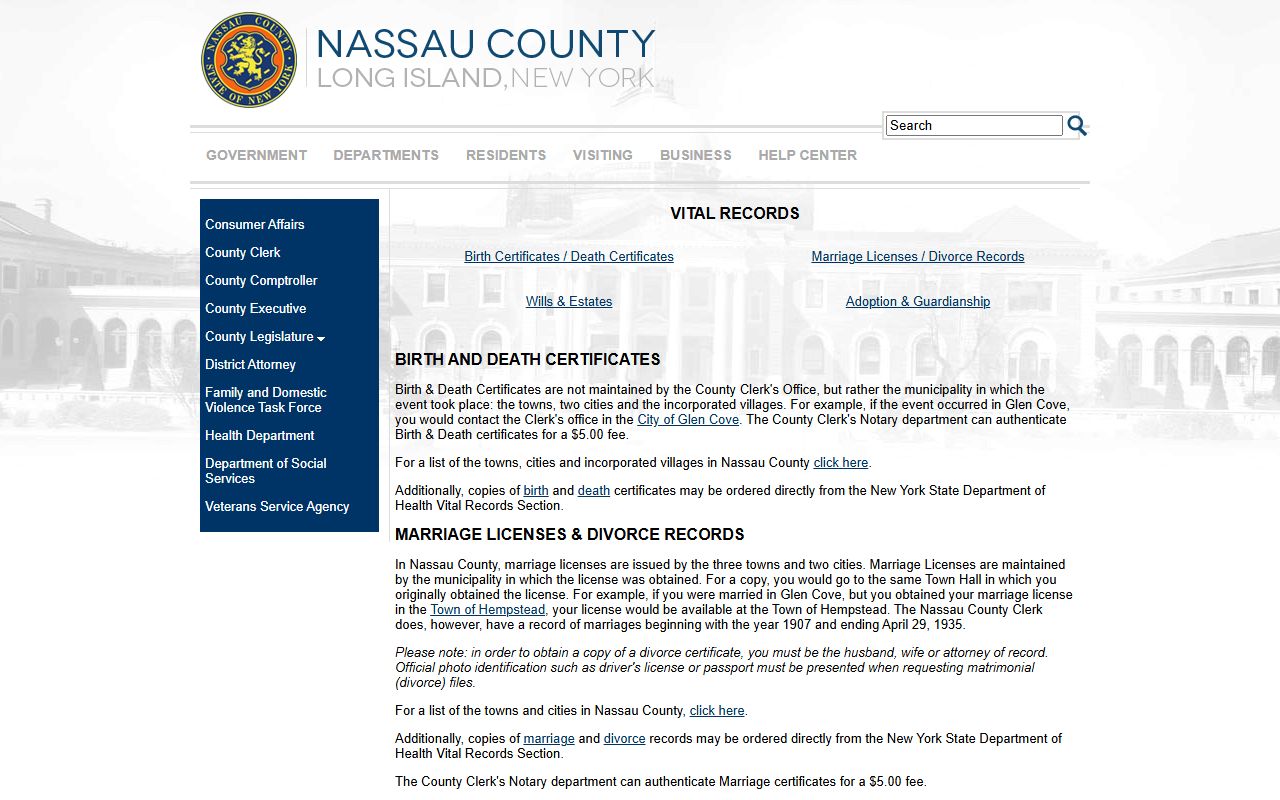
That page is the official source for the boundaries between county, municipal, and state records.
Nassau County Marriage and Divorce Fees
Divorce copy fees come from the County Clerk legal schedule. Marriage license fees are set by each municipality, so they vary. The table below lists the County Clerk charges that apply to divorce records and searches.
| Service | Fee |
|---|---|
| Certified divorce judgment, first four pages | $5.00 minimum |
| Each additional page | $1.25 |
| Divorce/annulment judgment search | $5.00 |
| Court record search by name | $5 per 2-year period or fraction |
| Plain copy | $0.65/page ($1.30 minimum) |
If the index number is unknown, the name search runs $5 per consecutive two-year period, so knowing the year the divorce was filed keeps the cost down.
How to Look Up Nassau County Marriage Records
A marriage record lookup depends on the year. For a modern license, contact the issuing town or city clerk. For a record between 1907 and April 29, 1935, the Nassau County Clerk holds it. For an eligible certified copy from the state, the New York State Department of Health Vital Records Section can provide one.
Note: a marriage copy comes from the office that issued the license, so confirm which town or city handled it before ordering a certified copy.
How to Find Nassau County Divorce Records
Divorce decrees are Supreme Court matrimonial records filed with the Nassau County Clerk. Access is limited. Only the parties or the attorney of record can obtain a decree, under Domestic Relations Law § 235. A requester must present official photo ID, such as a driver's license or passport, when asking for a matrimonial file in person.
To request a decree, bring the index number, the date of the action, and the title of the action. If the index number is unknown, the Clerk can run a search, and the requester should give the year the divorce action was filed, not the year it was granted. Mail requests must be written and notarized.
Getting Certified Copies
A certified copy is the version courts and agencies accept. For a divorce judgment, the County Clerk charges a $5.00 minimum for the first four pages and $1.25 for each added page. The requester must be a party or the attorney of record, and a mail request needs a notarized signature.
For a marriage record, the certified copy comes from the issuing municipality or, where eligible, the state. Each office sets its own copy fee, so confirm the amount before sending payment.
New York State Vital Records Office
The state is a backup source for some records. The New York State Department of Health Vital Records Section can provide marriage copies where the requester is eligible. Eligibility rules limit who can order a record and for what purpose, so the state route is not open to everyone.
Birth and death certificates follow a different path again. Those are kept by the municipality where the event occurred, not the County Clerk, as the clerk's own FAQ explains. A death record may also matter for an estate, which is handled by Surrogate's Court rather than the County Clerk.
How to File for Divorce in Nassau County
A Nassau divorce is a Supreme Court matter, not a District Court one. The case opens with an index number from the County Clerk and runs through the matrimonial parts. The outline below traces the common steps for a New York divorce filed in Nassau.
- Confirm New York residency and the grounds for the divorce.
- Prepare the summons and complaint, or the uncontested divorce packet.
- File in Supreme Court and pay the index number fee, using NYSCEF where required.
- Serve the other spouse, then address child support, custody, and property.
- Submit the judgment packet and obtain the certified decree from the County Clerk if you are a party or attorney of record.
Matrimonial matters moved to the 101 County Seat Drive complex in June 2025, so use the current location when a hearing is scheduled. Self-help divorce forms are linked from the state court system for people without a lawyer.