
What Probate Covers in Nassau County
Probate is the court process for settling a person's estate after death. In Nassau, that work belongs to Surrogate's Court, not a probate court. The court handles the proving of wills, the appointment of executors and administrators, and the supervision that follows. It also hears guardianship and related estate matters.
The court's reach is broad. It covers probate of wills, administration when there is no will, small estates, letters testamentary and of administration, citations, waivers and renunciations, accountings, and decrees. The County Clerk's vital-records page confirms that estate records, including wills and administration files, are filed in Surrogate's Court, not with the County Clerk.
Probate Terms Defined
Estate law leans on a handful of old words. Knowing them makes a Surrogate's file far easier to read. The list below defines the terms that come up most often in a Nassau probate matter.
- Testator
- The person who made the will.
- Executor
- The person named in a will to carry out the estate.
- Administrator
- The person appointed to settle an estate when there is no will.
- Intestate
- Dying without a valid will, so state law decides who inherits.
- Letters testamentary
- The court document that lets an executor act for the estate.
- Small estate
- A simplified process for qualifying lower-value estates.
- Guardianship
- A court arrangement to manage the affairs of a person who cannot.
These terms appear across petitions, citations, and decrees in a Nassau estate file.
How to Search Nassau County Surrogate's Court
Estate records are searched through the court rather than the County Clerk. The Nassau Surrogate's Court page links WebSurrogate for case searches, along with a department directory, the citation calendar, and Surrogate's forms. For record questions, the court also gives a direct phone line. The exact WebSurrogate search fields should be checked on the live tool before relying on a specific layout.
Free legal research tools can help with the law behind a case. CourtListener, a free resource, hosts court opinions and dockets that can shed light on how similar estate questions were decided. The image below opens that resource.
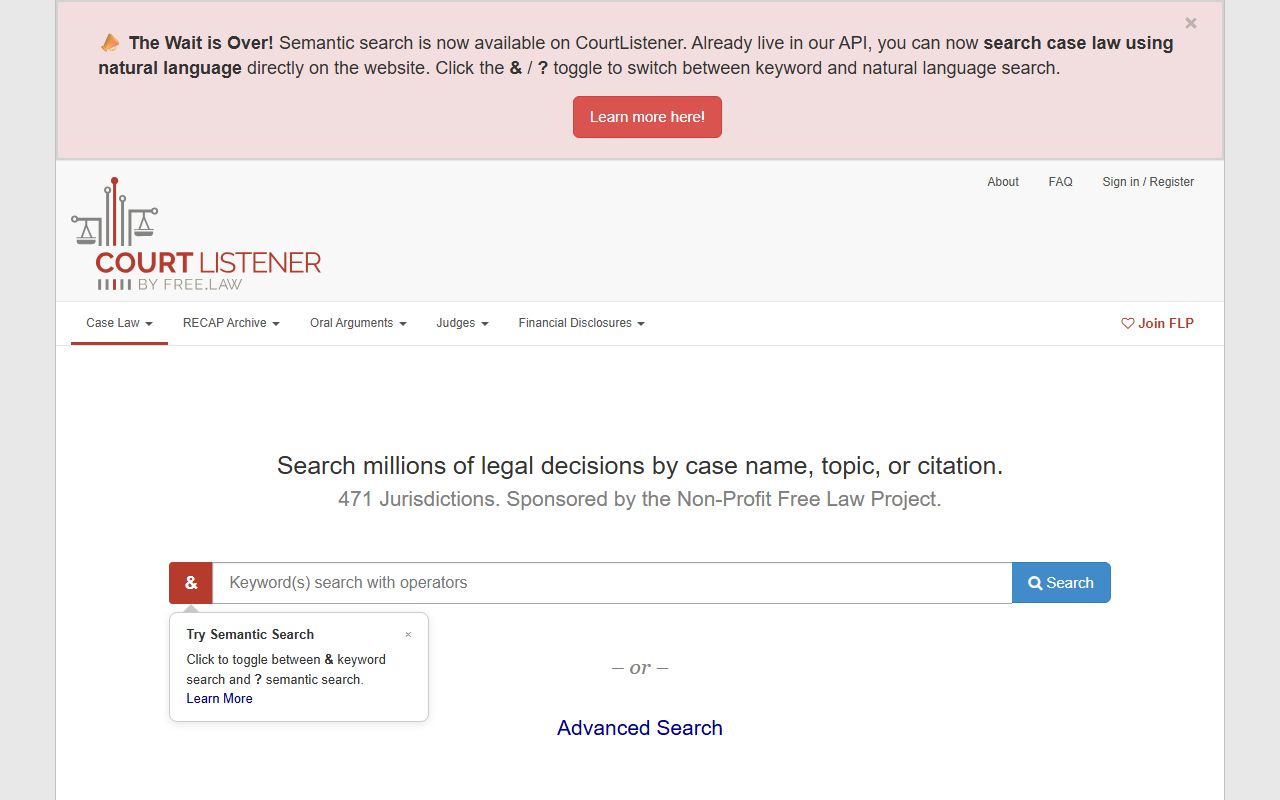
For the actual estate file, though, the Surrogate's Court clerk is the source. Older or sealed files may need a direct request to the clerk, and a name and approximate date of death speed the search. The court's record line can confirm whether a file is open to the public before a visit.
Surrogate's Court in Nassau County
Nassau has one Surrogate's Court, in the Mineola court campus. It shares the County Court building on Old Country Road. The contact block below lists the court and its chief clerk.
Nassau County Surrogate's Court
Hon. David P. Sullivan, Surrogate
262 Old Country Road
Mineola, NY 11501
516-493-3800
Chief Clerk 516-493-3805
The court page also links WebSurrogate, e-file protocol, guardianship and parentage petitions, the Public Administrator, and a "When Someone Dies" guide for families starting the process.
Nassau County Probate Filing Fees
Probate fees scale with the size of the estate under SCPA Article 24. A small estate costs little to file, while a large estate pays more. The table below lists the fee schedule by estate value, plus the common motion-type fees.
| Estate Value / Matter | Fee |
|---|---|
| Less than $10,000 | $45 |
| $10,000 but under $20,000 | $75 |
| $20,000 but under $50,000 | $215 |
| $50,000 but under $100,000 | $280 |
| $100,000 but under $250,000 | $420 |
| $250,000 but under $500,000 | $625 |
| $500,000 and over | $1,250 |
| Objections to probate of will | $150 |
| Demand for jury trial | $150 |
| Note of issue | $45 |
| Will for safekeeping (SCPA 2507) | $45 unless reduced |
The estate value sets the filing fee, so an accurate estate valuation matters before filing a petition.
The Nassau County Probate Process
A probate case follows a set order. It can be quick for a simple estate or long for a contested one. The steps below outline the common path through Nassau Surrogate's Court.
- Locate the original will and determine the estate value and the decedent's domicile.
- File a petition for probate, or for administration if there is no will, and pay the SCPA fee.
- Obtain citations, waivers, and consents from interested parties.
- Attend any required appearance, then receive letters to act for the estate.
- Collect assets, notify creditors and heirs, file an inventory or accounting, distribute the estate, and close the case.
Contested wills, missing heirs, real-property sales, and tax issues can stretch the timeline well beyond a simple estate.
A clean, uncontested estate with a clear will and cooperative heirs can move fairly quickly. The court provides a "When Someone Dies" guide and forms to help families and self-represented petitioners take the first steps without a lawyer.
Small Estates and Administration
Not every estate needs full probate. New York offers a simplified small-estate process for qualifying lower-value estates, which moves faster and costs less. The Surrogate's Court page links the small-estate forms, and the filing fee starts at $45 for an estate under $10,000.
When a person dies without a will, the estate is intestate, and the court appoints an administrator instead of an executor. Administration follows a similar path to probate, but state law decides who inherits rather than a will. The court issues letters of administration so the administrator can collect and distribute assets.
What Nassau County Surrogate's Court Records Show
An estate file builds up a clear paper trail. Each document marks a step in settling the estate. The list below shows the records a Nassau Surrogate's file commonly holds.
- The will, when one exists, and the probate petition.
- Citations, waivers, and consents from interested parties.
- Letters testamentary or letters of administration.
- Inventories and accountings of estate assets.
- Decrees and orders that close out the estate.
These records let heirs, creditors, and the public confirm how an estate was handled, subject to any restriction the court places on a file.
Restricted Surrogate's Court Records
Most probate files are open, but not all. Guardianship matters involving sensitive personal or medical information can be restricted, and clinical records tied to a case may be protected under Mental Hygiene Law § 33.13. Adoption-related matters are confidential under Domestic Relations Law § 114.
For the broader rules on court access and confidentiality, see the court records page. The County Clerk handles land and business records that an estate may touch, covered on the Nassau County Clerk page.
Even on an open file, sensitive personal data is shielded. The court masks identifiers like account numbers and may seal medical or guardianship details, while leaving the core estate record open for heirs and creditors to review.