
Arrest Records in Nassau County
An arrest record is the first paper trail in a criminal case. It is made when a police agency or the Sheriff books a person. Booking captures the name, the date, the charges, and basic identity data. In Nassau, the arresting agency may be a local police department, the County Police, or the Sheriff's Department, which runs the county jail in East Meadow. The record stays with the agency that made the arrest and with the jail that holds the person.
An arrest is not a conviction. A booking shows that police charged someone. It does not show guilt. Once charges are filed, the case moves to court, and a separate criminal court record begins. Nassau felonies usually route to County Court, while misdemeanors, violations, and many traffic crimes route to District Court. For the full case file and disposition, the better source is the Nassau County court records page. This page leads with the arrest side of that trail.
How to Search Nassau County Arrest Records
Nassau does not post a single public arrest blotter online in the official sources reviewed. So the search runs through a few official channels instead. For a criminal case with a future court date, the state WebCriminal tool searches by defendant name, case number, or summons number in selected courts. To confirm whether someone is in the county jail, the official path is the Correctional Center Inmate Records line and VINELink. The steps below cover the common route.
- Open WebCriminal defendant search and enter at least the first two letters of the first and last name.
- Pick the Nassau court. Options include Nassau County Court, Nassau District Court, and the Long Beach and Glen Cove City Courts.
- Review any case with a future appearance. WebCriminal posts a notice that updates can lag for some cases.
- To check current custody, call Nassau Inmate Records at 516-572-3802 or use VINELink. See the inmate records page.
The image below opens the WebCriminal landing page, where a Nassau criminal search starts by name or case identifier.
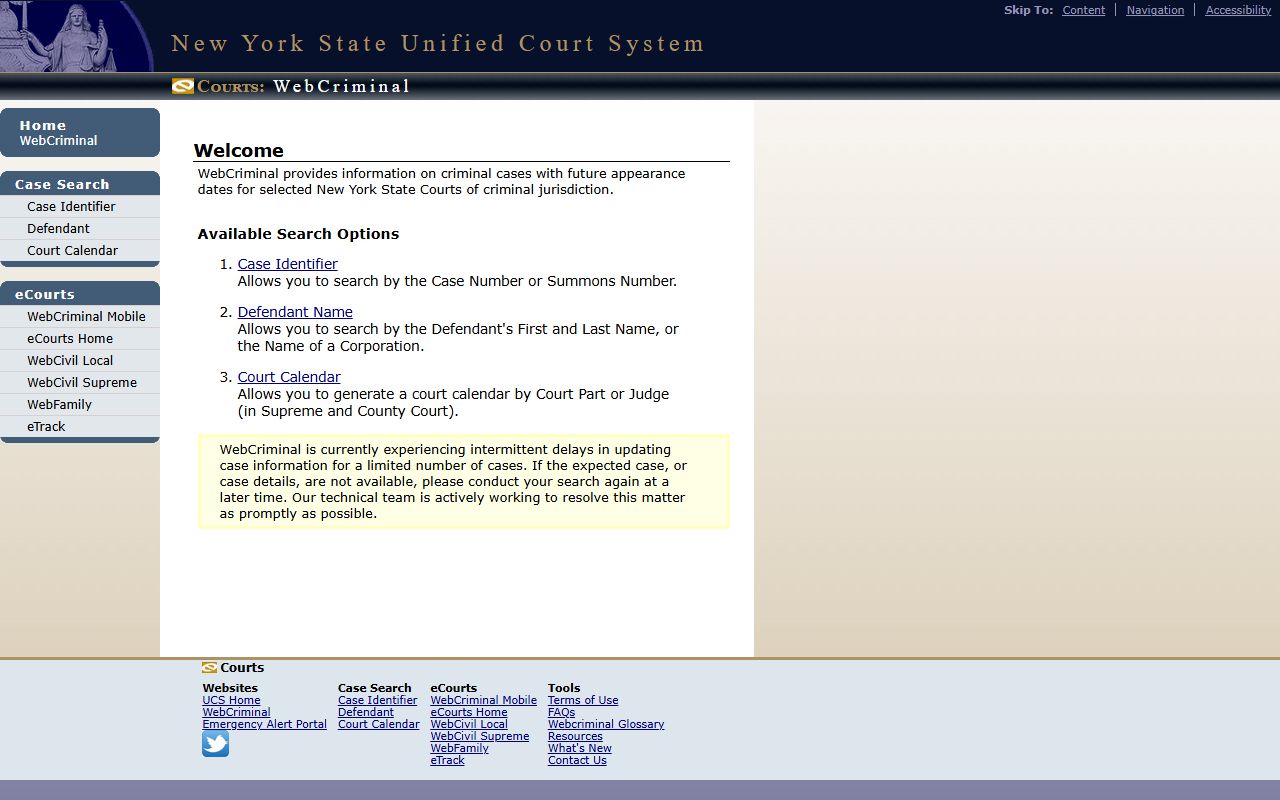
A full statewide criminal history is a different animal. WebCriminal covers only selected courts and only cases with a future date. New York does not give the public an open name-based rap sheet. A complete criminal history through the state is fingerprint-based and restricted to authorized requesters, so casual online "instant background" results should be treated with care.
Arrest Records vs. Criminal Court Records
The arrest record and the court record cover different stages. Booking creates the arrest record at the jail or police agency. The court record begins later, when a prosecutor files charges and the case opens in District or County Court. One is held by law enforcement. The other is held by the court clerk and the County Clerk.
| Arrest Record | Criminal Court Record | |
|---|---|---|
| Source | Sheriff / police agency | Court clerk / County Clerk |
| Created When | At booking | When charges are filed |
| Contents | Booking data, charges, custody status | Pleadings, motions, plea, disposition |
| Where to Look | Inmate Records, VINELink | WebCriminal, court records |
For a finished case, the most useful document is the certificate of disposition. District Court issues these, and it is the court-certified outcome of a criminal charge. That single paper often answers the question an arrest record alone cannot.
Charges vs. Convictions in Nassau County
People mix these up all the time. A charge is an accusation. A conviction is the result after a plea or a verdict. An arrest record and an open case both show charges. Only the disposition shows whether those charges led to a conviction, a dismissal, or an acquittal. Reading a Nassau record without that final step gives a false picture.
| Charge | Conviction | |
|---|---|---|
| Stage | Accusation at or after arrest | Plea or verdict in court |
| Burden of Proof | Probable cause | Beyond a reasonable doubt |
| Public Record | Yes, unless sealed | Yes, unless sealed |
| What It Means | Case is pending or charged | Guilt was established |
Note: a case that ends in dismissal or acquittal seals on its own under New York law, so a clean search result does not always mean no arrest ever happened.
Sealed vs. Expunged Records
New York seals records. It rarely expunges them. Sealing hides a record from the general public while letting a narrow set of agencies keep limited access. Expungement, by contrast, treats a record as if it never existed. For most criminal matters in Nassau, sealing is the tool the law uses, and the path depends on how the case ended.
| Sealed | Expunged | |
|---|---|---|
| Visibility | Hidden from public view | Destroyed or treated as never filed |
| Law Enforcement | Limited access kept | Very limited or none |
| Eligibility | Automatic on favorable end (CPL 160.50); by application under CPL 160.59 | Not a general New York remedy for criminal cases |
A case that ends in the accused's favor seals automatically under CPL § 160.50. Certain reduced or noncriminal outcomes seal under CPL § 160.55. Some drug and treatment cases qualify under CPL § 160.58, and certain old convictions may be sealed by application under CPL § 160.59 after a waiting period. The image below opens the official text of the core sealing statute.
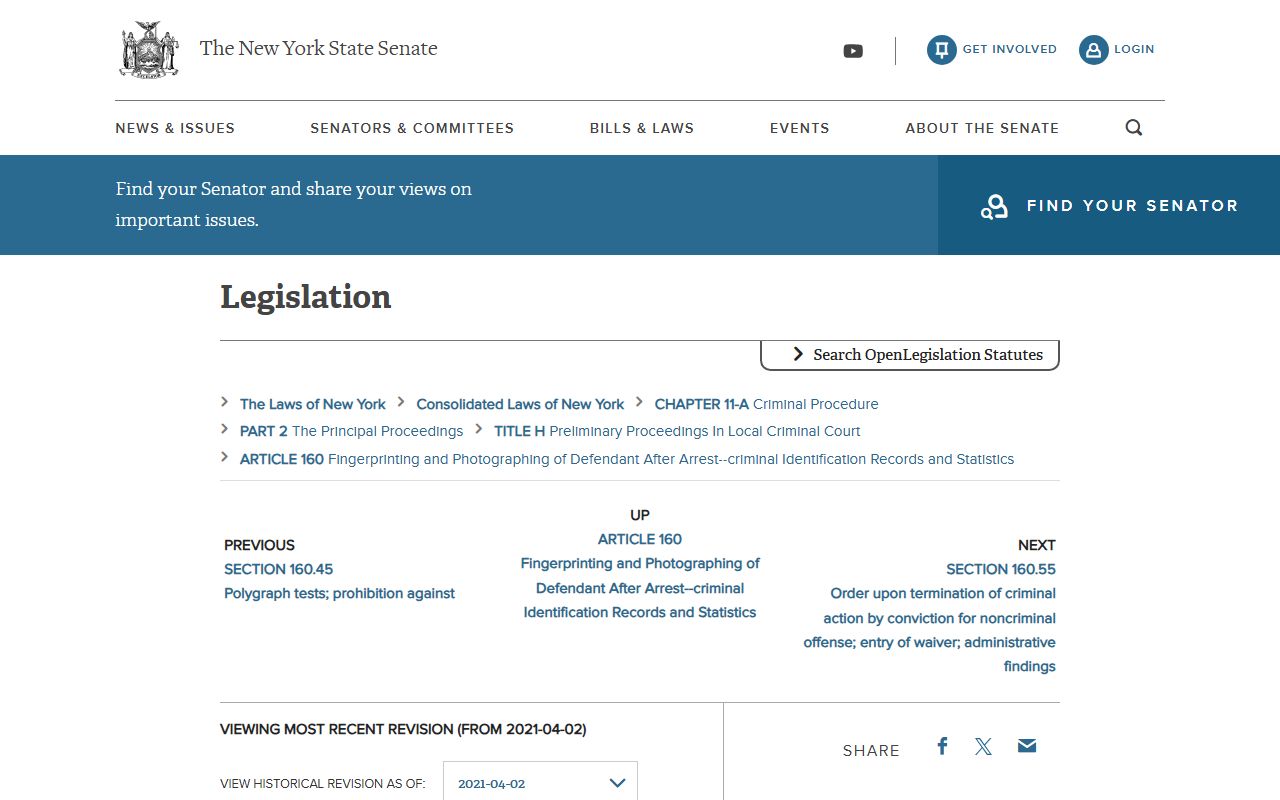
The statute spells out when a record seals after a case ends in favor of the accused. Even then, courts, prosecutors, law enforcement, and some licensing bodies may keep defined access.
What a Nassau County Arrest Record Shows
Arrest and early case data tends to carry a standard set of fields. The list below shows the parts a person is likely to see across booking data and the court tools that track a charged case. Sealed cases and protected identifiers do not appear.
- Name and Identity
- The defendant's name and basic identity data captured at booking.
- Arrest or Booking Date
- When the arresting agency or jail logged the person into custody.
- Charges
- The offenses alleged, with statute references in the court file.
- Court and County
- Nassau County Court, District Court, or a city court handling the matter.
- Case or Summons Number
- The identifier WebCriminal uses to pull a criminal case.
- Custody Status
- Whether the person is held, released, or has a future court date.
- Disposition
- The outcome once a case ends: dismissal, plea, conviction, or acquittal.
Not every field is public for every case. Personal identifiers like Social Security numbers and protected addresses are masked, and a sealed case drops off the public tools entirely.
Mugshots and Booking Photos
Booking photos are taken at the jail. That does not mean Nassau posts them online. The official county sources reviewed do not publish a public mugshot gallery, and there is no confirmed Nassau booking-photo search. Anyone needing booking information should go through Inmate Records at the Correctional Center rather than a private photo site.
Third-party mugshot sites are a known problem. They scrape arrest data, post photos, and sometimes charge to remove them. These sites are often stale, and they ignore later sealing. Because New York seals many cases, a mugshot site can keep showing a photo long after the law has closed the case. Treat those results as unverified and check the court record instead.
Statewide and Federal Criminal Searches
Some criminal matters reach past the county. New York's sex offender registry, run by the Division of Criminal Justice Services, is a public search by name, county, or ZIP. It is not a general arrest database, but it is the one open statewide criminal-status tool the public can use freely. Federal arrests are different again, and those route through the U.S. courts rather than Nassau.
For people held or prosecuted at the federal level, the U.S. District Court for the Eastern District of New York covers Nassau. Federal case records come through PACER, and federal custody is searched through the Bureau of Prisons inmate locator. None of these are filed with the Nassau County Clerk, so a county search will not surface a federal arrest.
Background Check Considerations
There is a real gap between a casual lookup and a legal background check. A formal check used for hiring, housing, or credit must follow the federal Fair Credit Reporting Act and New York's own screening rules. An online name search does not meet that bar. It can miss sealed cases, mix up common names, and show charges that were later dropped.
Important: This site is a private resource, not a consumer reporting agency under the FCRA, and its data cannot be used for credit, employment, tenant, or insurance decisions.
Restricted Criminal Records in Nassau County
Several categories stay out of public view. Juvenile delinquency and PINS matters sit in Family Court and are closed under Family Court Act § 166. Sealed dismissals and acquittals fall under CPL § 160.50. Mental health filings are protected under Mental Hygiene Law § 33.13. Grand jury minutes are secret unless a court orders disclosure.
Open investigations are also off limits. Search warrants and sealed indictments may not be public before an arrest or execution. For the rules behind these limits and the FOIL framework for agency records, see the public records page. To resolve or check on an active warrant, see the warrant records page.