
Nassau County Supreme Court Overview
The Supreme Court is New York's court of general jurisdiction. The name confuses newcomers, because in most states the supreme court is the highest court. In New York it is the main trial court. Nassau's Supreme Court sits at 100 Supreme Court Drive in Mineola, on the county-seat court campus, and shares that address with the district court administration.
In practice, Nassau Supreme handles civil matters above the District Court limits, generally suits over $25,000, plus matrimonial cases like divorce. It also hears foreclosures and complex commercial disputes through its Commercial Division. Felony criminal prosecutions usually go to County Court, even though the Supreme Court holds broad criminal authority in theory. The image below opens the official court address campus map.

Use the exact address for GPS. Several Nassau court buildings have similar names and sit close together, and some court functions moved in 2025.
Nassau County Courts in the Trial System
Supreme Court is one rung on a ladder. Nassau's courts split work by case type and level, from the lower District Court up to the appellate courts. The table below lays out the hierarchy and where Supreme Court fits.
| Level | Court | Nassau Role |
|---|---|---|
| Highest state appeal | Court of Appeals | Final state-law appellate court in Albany. |
| Intermediate appeal | Appellate Division, Second Department | Hears appeals from Nassau trial courts. |
| General trial | Supreme Court | Civil over $25,000 and matrimonial matters. |
| County trial | County Court | Felonies and limited civil matters. |
| Estates | Surrogate's Court | Probate, administration, and guardianship. |
| Lower trial | District Court | Claims to $15,000, misdemeanors, and traffic crimes. |
Family Court, a specialized court, handles custody, support, and related family matters with restricted public access. The lower courts are profiled on the District Court page.
How to Search Nassau Supreme Court Records
Supreme Court civil records are searchable for free through the state's case tools. The main one is WebCivil Supreme, which returns past, present, and future civil case information for New York Civil Supreme Courts, with Nassau in the court list. For electronically filed matters, NYSCEF lets a guest search without a login. The steps below cover a typical Nassau Supreme search.
- Open WebCivil Supreme and choose index, party, attorney, or justice search.
- Enter the index number or party name and select Nassau County Supreme Court.
- Filter by year of filing or case status, then run the search.
- For e-filed matters or documents, switch to the NYSCEF guest search instead.
Matrimonial files are an exception. A divorce file goes only to the parties or the attorney of record, even though the docket may appear in a search. Certified copies come from the County Clerk.
Supreme Court vs. County Court vs. District Court
These three trial courts split most of Nassau's caseload. The line between them is mostly about case type and dollar amount. The comparison below shows what each one handles.
| Supreme Court | County Court | District Court | |
|---|---|---|---|
| Civil | Over $25,000; matrimonial | Limited civil | Up to $15,000 |
| Criminal | Broad authority | Felonies | Misdemeanors, arraignments |
| Location | 100 Supreme Court Dr | 262 Old Country Rd | 99 Main St, Hempstead |
| Records held by | County Clerk | County Clerk | District Court clerk |
Because the County Clerk keeps both Supreme and County Court files, those records are searched through the same clerk and the same state tools, covered on the court records page.
How a Case Moves Through the Nassau County System
A civil case follows a path. It starts with a filing and an index number, moves through motions and conferences, reaches trial or settlement, and may end in an appeal. The flow below traces the common route for a Nassau Supreme Court civil matter.
Filing and index number → Request for Judicial Intervention → motions and conferences → note of issue and trial → judgment → appeal to the Appellate Division.
Each step leaves a record. The index number opens the case, the Request for Judicial Intervention brings a judge in, and the note of issue places the case on the trial calendar. An appeal goes up to the Appellate Division, Second Department. The image below opens the NYSCEF home page, where many of these filings are made and searched.
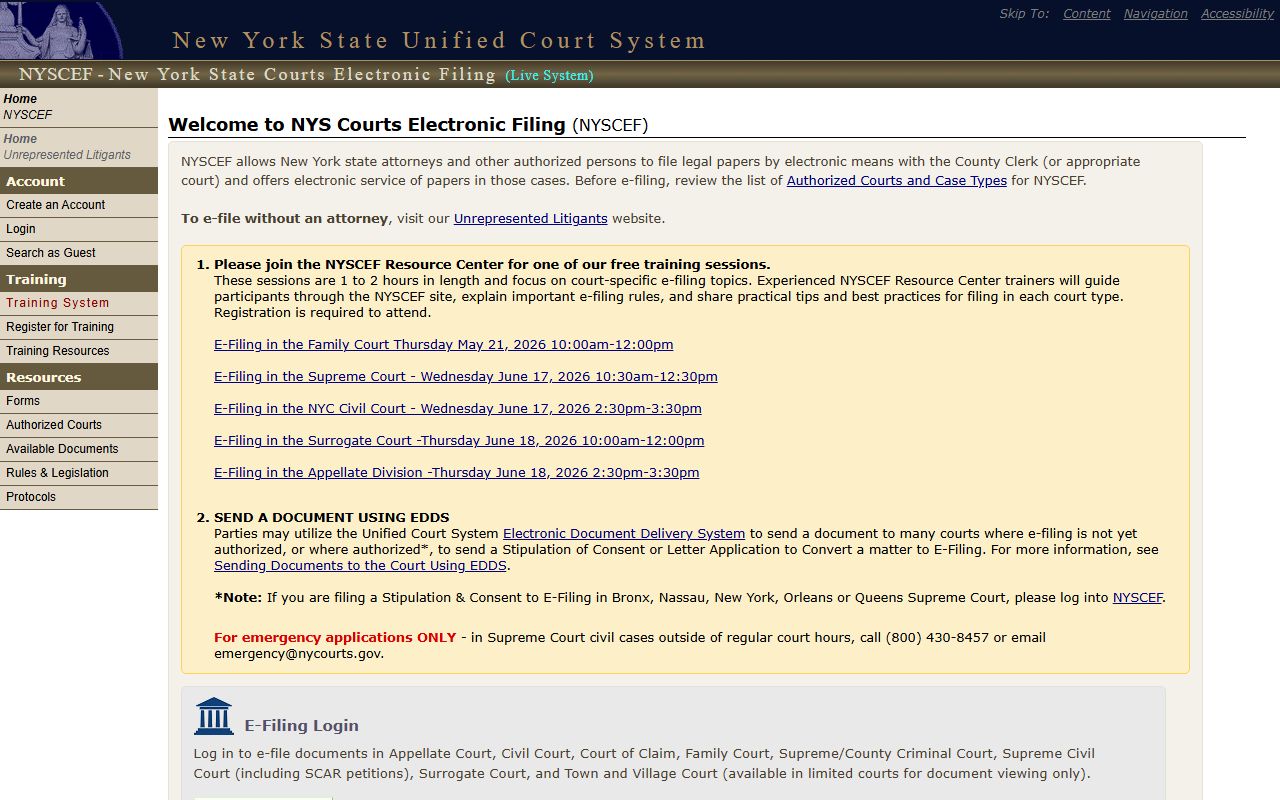
NYSCEF handles electronic filing and offers a free public guest search for e-filed Supreme Court cases.
Civil, Matrimonial, and Specialty Divisions
Nassau Supreme Court runs several parts. The general civil parts handle the bulk of suits. Matrimonial parts handle divorce and related relief, and those files are restricted to the parties or the attorney of record. The Commercial Division hears complex business disputes under statewide commercial rules.
Specialty parts round out the court. Nassau lists Integrated Domestic Violence, Foreclosure, and Commercial Division parts, along with opioid and treatment-court resources. Matrimonial matters moved with Family Court to the 101 County Seat Drive complex in June 2025, so older addresses for divorce parts are out of date.
The Integrated Domestic Violence part is worth a note. It brings related criminal, family, and matrimonial matters involving one family before a single judge, which keeps a family's cases from being scattered across courts. Public access to the underlying family material stays restricted even when the matters are heard together.
The Tenth Judicial District
Nassau sits in New York's Tenth Judicial District, with district administration at 100 Supreme Court Drive in Mineola. Appeals from Nassau Supreme, County, Family, and Surrogate's Courts go to the Appellate Division, Second Department, which covers Long Island and other downstate counties. The Court of Appeals in Albany is the final state-law authority.
This structure matters for record seekers. An appeal record lives with the appellate court, not the trial-court clerk, so a party tracking an appeal looks to the Second Department rather than the Nassau County Clerk.
Lower and Local Courts
Below Supreme and County Court, Nassau relies on its District Court and several local courts. District Court in Hempstead handles lower civil claims, small claims, landlord-tenant, misdemeanors, and traffic crimes. The cities of Long Beach and Glen Cove run their own city courts, and town and village justice courts handle local matters.
Nassau's District Court is itself unusual. New York has District Courts only in Nassau and parts of Suffolk, so most counties do not have this layer at all. It centralizes a wide range of lower civil and criminal work that elsewhere would be split among town and village courts.
For the District Court's jurisdiction, hours, and department directory, see the District Court page. For the clerks who keep each court's records, see the Court Clerks page.