
About the Nassau County Clerk's Office
Maureen O'Connell serves as the Nassau County Clerk. The office is a state constitutional office that acts as Clerk of the Supreme and County Courts and as an agent for state and federal governments. It also records documents tied to real property in Nassau County and keeps the official index of property ownership. Locals know it as the blue building at 240 Old Country Road in Mineola, on the corner of Old Country Road and County Seat Drive.
Hours run Monday, Wednesday, Thursday, and Friday from 9 a.m. to 4:30 p.m., and Tuesday from 9 a.m. to 7 p.m. Two rooms keep their own hours. The Court Records Document Room, Room 106, closes at 3:30 p.m. on Monday, Wednesday, and Friday. The Land Recording Department, Room 105, is closed from 12:30 p.m. to 1:30 p.m. each weekday. The image below opens the official office overview.
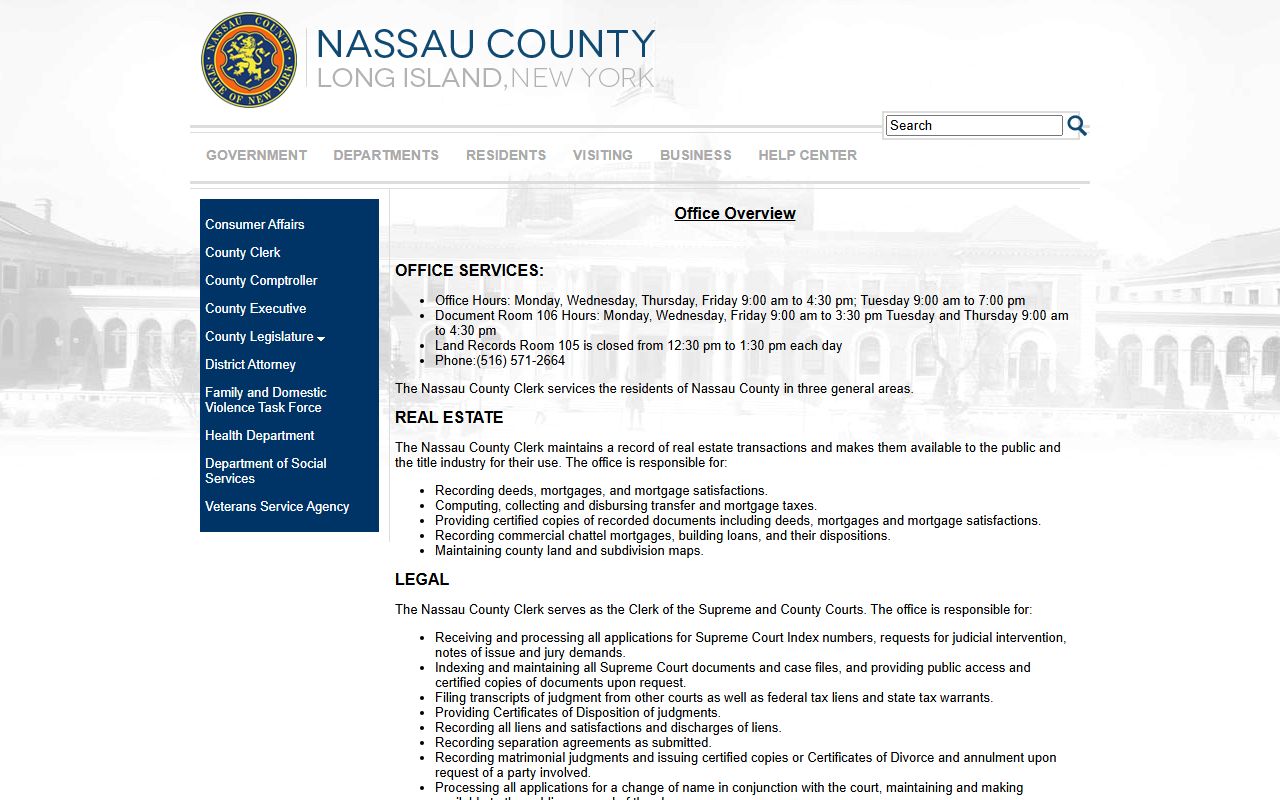
The overview page lists hours, services, and the records the office is responsible for. It is the right starting point before a visit.
What the Nassau County Clerk Does
The office splits its work into three broad areas. Each one covers a different kind of record, and knowing which area holds what saves a trip to the wrong counter. The list below follows the office's own breakdown.
- Real estate - Records deeds, mortgages, satisfactions, chattel mortgages, building loans, county land maps, and subdivision maps; computes and collects transfer and mortgage taxes.
- Legal - Serves as Clerk of the Supreme and County Courts; processes and keeps civil and criminal court records filed there; handles name-change applications with the court.
- Business - Files business certificates and keeps records of businesses incorporated in New York and doing business in Nassau County.
The office also draws clear lines around what it does not hold. Birth and death certificates come from the municipality where the event happened. Marriage licenses come from the towns and cities. Probate records are filed in Surrogate's Court, not the County Clerk. Those boundaries are covered on the marriage and divorce and Surrogate's Court pages.
How to Request a Certified Copy
A certified copy is the version courts and agencies accept. The County Clerk issues certified copies of Supreme and County Court records. For a divorce file, access is limited to the parties or the attorney of record, so identity matters at the counter. The steps below follow the office's stated process.
- Gather the index number, the date of the action, and the title of the action.
- Bring official photo ID, such as a driver's license or passport, for any matrimonial file.
- Visit Room 106 during open hours, or mail a written, notarized request if you cannot appear.
- Pay the certified copy fee. The first four pages of a divorce judgment cost a $5 minimum, then $1.25 per added page.
If the index number is unknown, the office can run a search. The image below opens the County Clerk FAQ, which explains record, divorce, and land-record requests in detail.
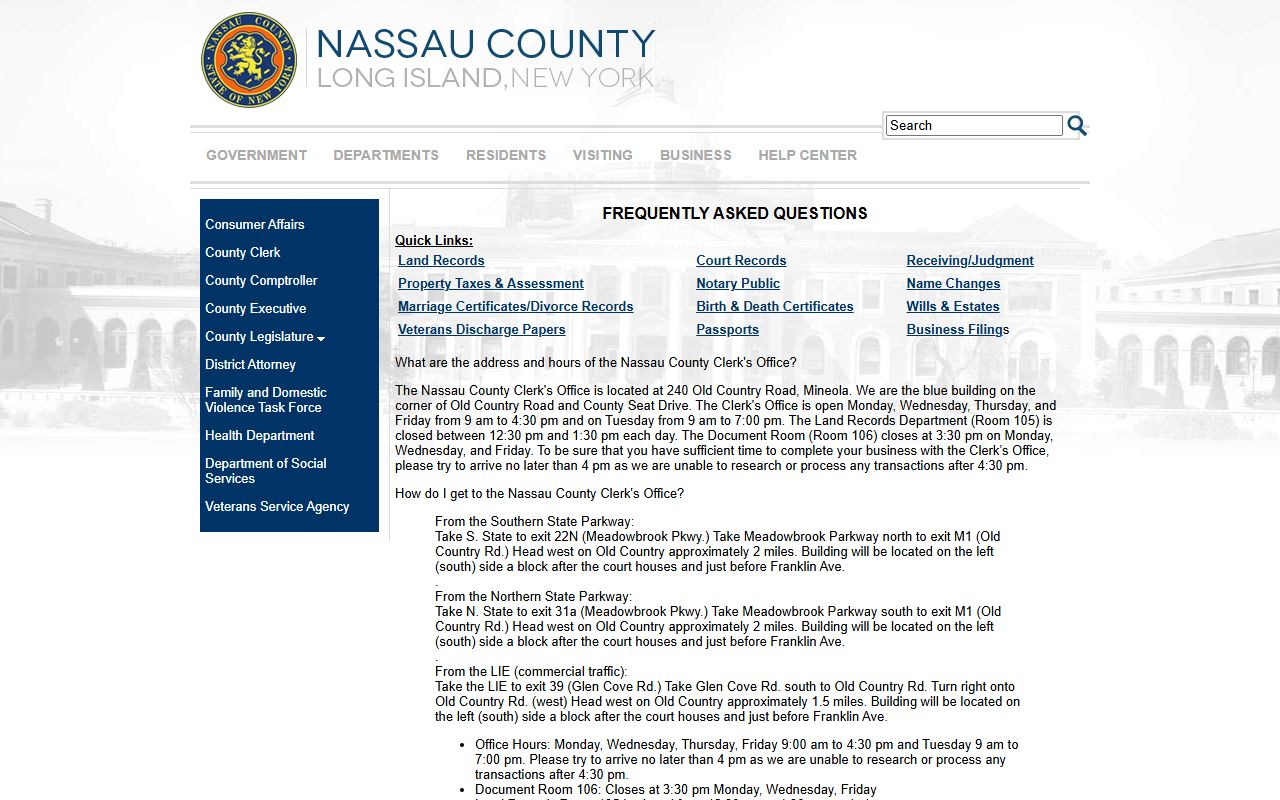
The FAQ is the office's plain-language guide to most counter requests, from court records to notary and passport questions.
What to Provide for a Records Request
A request moves faster when it carries the right details. For a court or divorce record, the office asks for specific identifiers. The table below lists what to bring and why each item helps.
| Item | Required | Why It Helps |
|---|---|---|
| Index Number | Preferred | Pulls the exact file without a search fee. |
| Date of Action | Yes for divorce | Use the year the action was filed, not the year granted. |
| Title of Action | Yes for divorce | The case caption naming the parties. |
| Photo ID | Yes for matrimonial | Confirms you are a party or attorney of record. |
| Notarized request | Mail only | Required for written mail requests. |
Without an index number, a name search costs $5 per consecutive two-year period or fraction, so an exact year saves money.
Nassau County Clerk Fees
The legal division fee schedule sets prices for filing, copying, certifying, and searching Supreme and County Court records. The office accepts MasterCard and Visa, plus cash and checks at the counter. The table below lists the common charges.
| Service | Fee |
|---|---|
| Index Number | $210 |
| Index Number, foreclosure | $400 |
| Order to Show Cause | $45 (index number required) |
| Request for Judicial Intervention | $95 |
| Note of Issue | $30 (RJI on file) |
| Motion or Cross-Motion | $45 (RJI on file) |
| Notice of Appeal | $65 |
| Plain copy | $0.65/page ($1.30 minimum) |
| Certified copy | $1.25/page ($5.00 minimum) |
| Exemplification | $10 plus certification |
| Court record search by name | $5 per 2-year period or fraction |
| Divorce/annulment judgment search | $5 |
The image below opens the official legal division fee page, which lists the full schedule. Filing fees for other matters scale with the type of action.
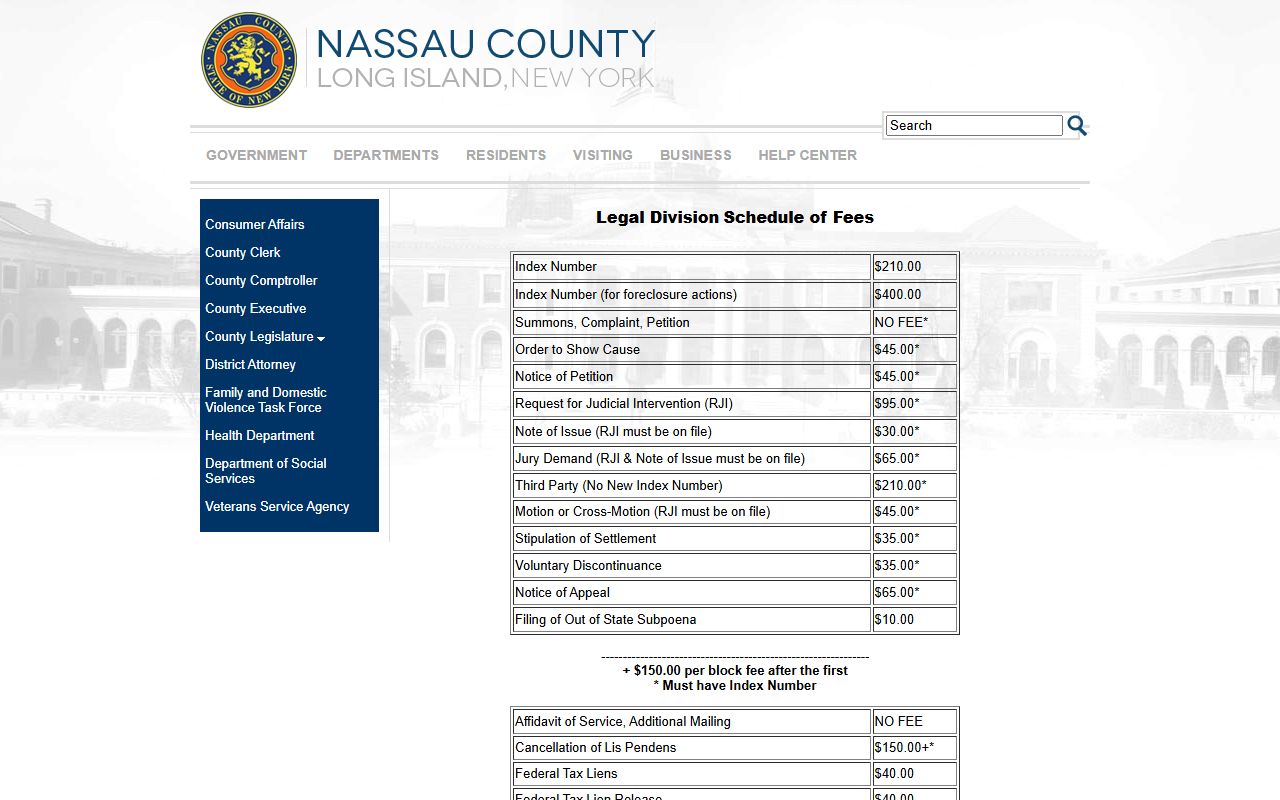
Surrogate's Court and District Court keep their own fee menus, covered on the Surrogate's Court and Court Clerks pages.
Common Nassau County Clerk Records
Beyond court files, the office handles a long list of everyday records. These are the documents people most often come to the blue building to record or pull.
- Deeds, mortgages, and satisfactions for Nassau real property.
- Notices of pendency, mechanics liens, and federal tax liens.
- Civil judgments and transcripts of judgment.
- Business certificates and incorporation records.
- Name-change records processed with the court.
Land records sit in Room 105, which closes for lunch each weekday, so plan a land-record visit around that window.
Mail and Online Filings
Not every request needs a visit. Mail requests work for many records, but a matrimonial request must be written and notarized, with proof you are a party or attorney. Electronic filing for Supreme and County Court civil matters runs through NYSCEF, which also offers a free public guest search. For agency records outside the courts, the county uses a FOIL web form, covered on the public records page.
Online tools cut down on counter trips, but they do not replace the office for certified copies or sealed files. A NYSCEF search can confirm a case and pull public e-filed papers, yet a court-stamped certified copy still comes from the Clerk. Plan the method around what the end use requires: a quick read can be online, while a filing or a legal proceeding usually needs the certified version.
Note: divorce decrees go only to the parties or the attorney of record, so a notarized mail request must show that standing before the office will release the file.