
How to Search Nassau County Court Records Online
The main free portal for Nassau Supreme and County Court civil cases is WebCivil Supreme. It returns past, present, and future civil case information for every New York State Civil Supreme Court, with Nassau Supreme and Nassau County Court in the court dropdown. The search is free. No login is required. WebCivil filter dates start in 1983 and run forward to the current year, so older paper files still need a clerk request.
Before starting a Nassau County court records search, pin down four things: the court, the case or index number if known, the names of the parties, and a rough year. Civil matters use index numbers. Criminal matters use case or summons numbers. Family Court is not searchable to the public at all under Family Court Act § 166.
The image below opens the WebCivil Supreme search form where each Nassau filter sits.
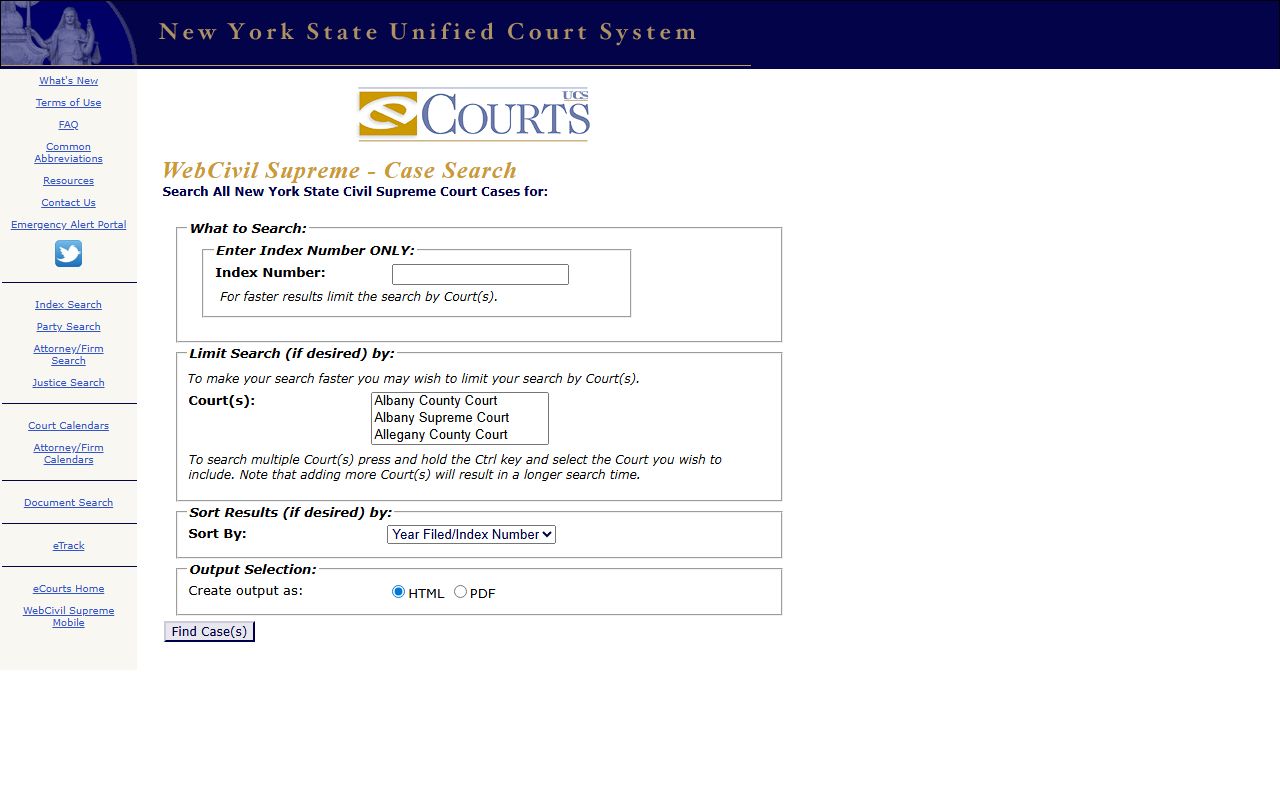
The search form lets a user pick Index Search, Party Search, Attorney/Firm Search, or Justice Search at the top, then add filters by court, year, status, and sort order.
- Open WebCivil Supreme search and choose a search mode. Index is fastest if the number is known.
- Type the name or number. Party search wants the last name first. Index search wants the index number alone, with no court prefix.
- Pick Nassau County Supreme Court or Nassau County Court from the court list. Hold Ctrl to add both.
- Filter by year of filing if known. Set case status to Open (Active, Restored) or All.
- Sort by year filed, party name, or court appearance date and run the search.
- Click the index number to open the docket and case detail. Save or print the page; certified copies need a clerk visit or mail order.
WebCivil Supreme Search Fields for Nassau Cases
The WebCivil Supreme form gives several entry points for a Nassau record. Each field changes what the search needs and what it returns. The table below mirrors the live form. Use it to plan a search before opening the portal.
| Field | Type | Required | Format Notes |
|---|---|---|---|
| Search mode | Tab | Yes | Index, Party, Attorney/Firm, or Justice search. |
| Index Number | Text | Index mode only | Index number only. No court code. |
| Name | Text | Party mode only | Last name first works best. |
| Attorney Name | Text | Attorney mode | Attorney or firm name. |
| Justice Name | Text | Justice mode | First and last name speeds results. |
| Role | Radio | Optional | Plaintiff/Petitioner, Defendant/Respondent, Other Roles, All Roles. |
| Court(s) | Multi-select | Optional | Includes Nassau County Court and Nassau Supreme Court. Ctrl-click for multiple. |
| Year of Filing | Dropdown | Optional | 2026 through 1983. |
| Case Status | Radio | Optional | Open (Active, Restored) or All. |
| Future Appearances | Radio | Optional | Yes or No filter for upcoming dates. |
| Sort By | Dropdown | Optional | Year Filed, Plaintiff/Petitioner, Defendant/Respondent, Court Appearance Date. |
| Output | Radio | Optional | HTML or PDF. |
Most public users start with Party Search. Attorneys and firms often go straight to Index. Court calendars and judges' parts are easier to find through the Justice mode, which lets a user pull all Nassau cases on a given judge's calendar.
NYSCEF and WebCriminal for Nassau Court Records
WebCivil does not show every Nassau filing. Electronically filed matters live in NYSCEF. NYSCEF gives a public user free guest access without a login. The NYSCEF guest case search takes a full case number, an attorney file number, a third-party index number, or a county and case-type combination. Filings that the court directs to e-file, plus voluntary e-filings under the program, all show up there.
For criminal matters with a future appearance, the right portal is WebCriminal. It covers selected courts only and posts an open notice that updates can lag. WebCriminal defendant search needs at least the first two characters of the first and last name, or the first five characters of a corporation name. The Nassau dropdown lists Glen Cove City Court, Long Beach City Court, Nassau County Court, Nassau County Supreme Court, and Nassau District Court.
The image below opens the NYSCEF home page and shows the guest-search entry point.
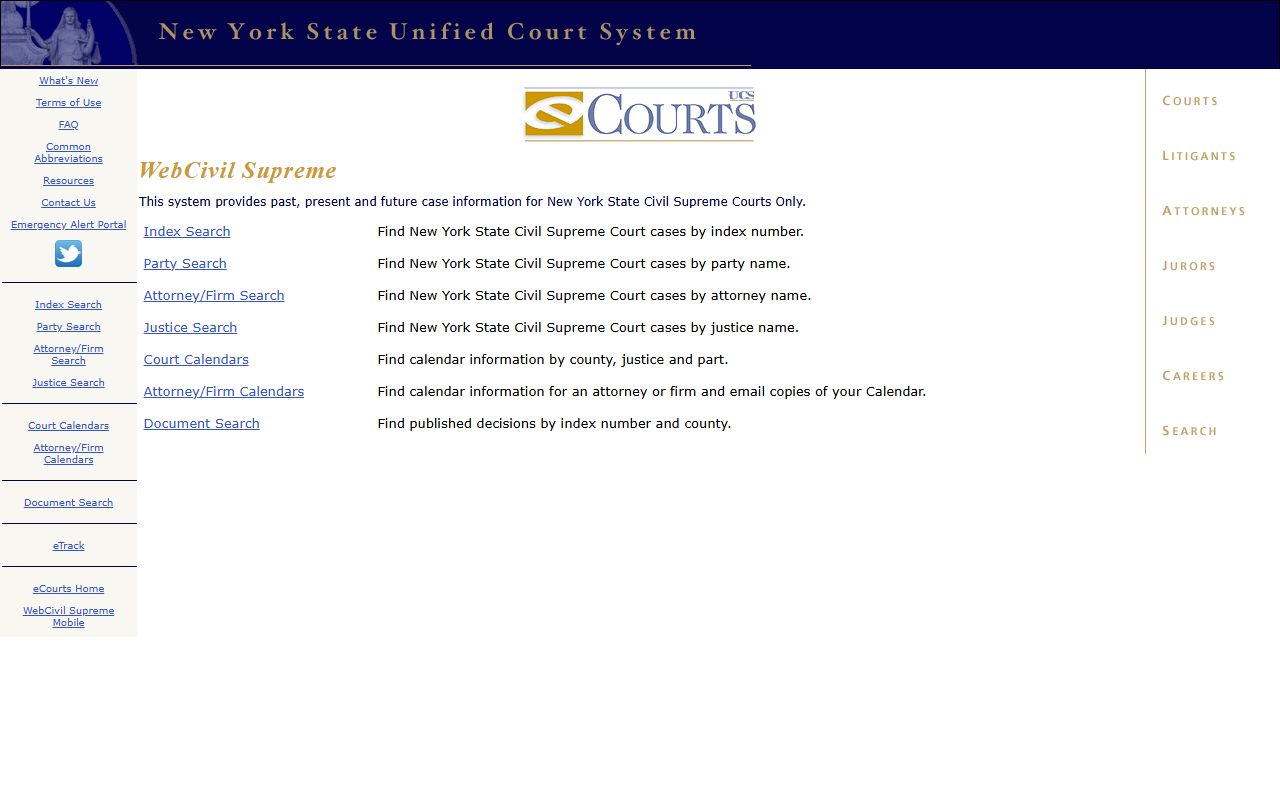
For criminal record details, the WebCriminal case identifier search accepts a case number or a summons number. Sealed records do not appear in either tool.
Types of Nassau County Court Records
Nassau records split by court. Each clerk keeps the files for its own court, with the County Clerk handling Supreme and County Court paper files and the Court Clerks page covering the other trial courts.
- Civil Supreme - Complaints, answers, motions, orders, judgments, notes of issue, and e-filed docs in NYSCEF when public.
- County Court - Felony indictments, superior court informations, pleas, sentences, certificates of disposition, and limited civil matters.
- District Court civil and criminal - Civil up to $15,000, small claims to $5,000, landlord-tenant, misdemeanors, violations, infractions, and traffic crimes.
- Surrogate's Court - Wills, probate petitions, letters testamentary, small estates, accountings, and guardianships. See the Surrogate's Court page.
- Family Court - Custody, support, paternity, family offense, PINS, juvenile, adoption. Not open to general public inspection.
- Matrimonial / divorce - Supreme Court files held by the Nassau County Clerk. Decrees go only to parties or the attorney of record.
- Land and judgment records - Deeds, mortgages, satisfactions, mechanics liens, federal tax liens, notices of pendency, and transcripts at the County Clerk.
For traffic tickets that do not charge a crime, the relevant file usually lives with a town, village, city, or DMV record office. See the traffic court records page for the split between court traffic files and DMV driver records.
What Nassau County Court Records Show
A Nassau record is a structured file. Each case carries an index, summons, or case number, plus the court, the parties, attorneys, filing date, status, and a docket of every motion, order, and appearance. Civil cases run on index numbers. Criminal cases run on case or summons numbers. The fields below appear across WebCivil, NYSCEF, and WebCriminal, with small differences from one portal to the next.
- Case / Index Number
- Nassau Supreme uses index numbers. WebCriminal also takes a summons number. NYSCEF supports full case numbers and third-party index numbers.
- Court and County
- Nassau Supreme, County, District, Surrogate's, Family, Long Beach, or Glen Cove.
- Filing Date
- When the case was filed. WebCivil filter dates go back to 1983.
- Parties
- Plaintiff or petitioner, defendant or respondent, and corporation names. Role filter lets users narrow by party type.
- Attorneys
- Counsel of record, firm names, and contact numbers.
- Charges or Cause
- Civil cause of action, or criminal charge with statute reference.
- Status
- Open (Active, Restored), Disposed, or sealed.
- Disposition
- Dismissed, plea, conviction, judgment, settlement, or default.
- Sentence or Judgment
- Money amount, jail, probation, or order text.
- Appearances
- Future court dates and calendared parts. WebCivil and WebCriminal both expose this.
Sensitive entries get masked. SSNs, financial account numbers, minor names, and protected addresses are not part of the public view. Sealed criminal cases under CPL § 160.50 drop off WebCriminal entirely. Sealed civil files removed under 22 NYCRR § 216.1 may show only minimal metadata.
Public Access Laws for Nassau Court Records
New York splits public records access into two systems. The Freedom of Information Law (FOIL) at Public Officers Law Article 6 governs state and local agency records, including Nassau County departments. Court case files do not run on FOIL. NY Courts states plainly that FOIL does not work as a general case-file request system. Court access runs through court rules, the Judiciary Law, and case-specific confidentiality statutes.
For Nassau county departments, the right tool is the Nassau FOIL web form. Under the law, agencies generally have five business days to grant, deny, or acknowledge the request, with an approximate response date for longer pulls. Public Officers Law § 89 sets the appeal mechanics. A denial may be appealed within 30 days.
Key Statutes:
Public Officers Law § 84 - FOIL's legislative declaration. The public's business should be open to the public.
Public Officers Law § 87 - Agency access rights and exemptions, including privacy and law-enforcement carve-outs.
Judiciary Law § 4 - Court sittings are public, with limited exceptions.
Family Court Act § 166 - Family Court records are not open to indiscriminate public inspection.
CPL § 160.50 - Sealing after a criminal case ends in favor of the accused.
For Nassau Supreme Court civil files, the open-court baseline of Judiciary Law § 4 applies. Court files are public unless a statute or judge restricts them. To seal a civil case in Nassau, a party must show good cause and the judge must make written findings under court rule 22 NYCRR § 216.1.
Restricted Nassau County Court Records
Several Nassau record types stay out of the public file. Domestic Relations Law § 235 limits matrimonial files. That is why the Nassau County Clerk gives a divorce decree only to the parties or the attorney of record. DRL § 114 makes adoption records confidential. Clinical records covered by mental health filings sit under Mental Hygiene Law § 33.13. Family Court files of every kind sit behind Family Court Act § 166.
New York seals records rather than expunges them. A case that ends in dismissal or acquittal under CPL § 160.50 seals on its own. Other sealing paths under CPL § 160.55, CPL § 160.58, and CPL § 160.59 need an application, a waiting period, and judicial findings. Even after sealing, law enforcement, courts, prosecutors, and licensing agencies may keep limited access.
Note: A clean WebCriminal result on a Nassau name often means a sealed dismissal, not the absence of any case.
Nassau County Court Records Fees
The Nassau County Clerk legal fee schedule sets prices for filing, copies, and searches in Supreme and County Court. Plain copies cost $0.65 per page with a $1.30 minimum. Certified copies cost $1.25 per page with a $5 minimum. A name search costs $5 per consecutive two-year period or fraction. The Clerk accepts MasterCard and Visa, plus cash and checks at the counter.
| Service | Fee |
|---|---|
| Index number | $210 |
| Index number, foreclosure | $400 |
| Request for Judicial Intervention | $95 |
| Note of Issue | $30 (RJI on file) |
| Motion or Cross-Motion | $45 (RJI on file) |
| Notice of Appeal | $65 |
| Plain copy per page | $0.65 ($1.30 minimum) |
| Certified copy per page | $1.25 ($5 minimum) |
| Exemplification | $10 plus certification |
| Name search | $5 per 2-year period or fraction |
| Divorce judgment search | $5 |
District Court has its own fee menu through the Court Clerks page for criminal certificates of disposition, civil filings, and small claims. Surrogate's fees scale by estate value under SCPA Article 24.