
Nassau County District Court Overview
District Court is a Nassau institution. New York created District Courts only in Nassau and parts of Suffolk, so it is a Long Island feature, not a statewide one. The court sits at 99 Main Street in Hempstead and centralizes a wide range of lower civil and criminal work that other counties spread across town and village courts.
The court is open Monday through Friday, 9 a.m. to 5 p.m. Calendars are called at 9:30 a.m., and all business must start by 4:30 p.m. The main information line is 516-493-4200, and the Chief Clerk's number is 516-493-4159. The image below opens the official District Court overview page.
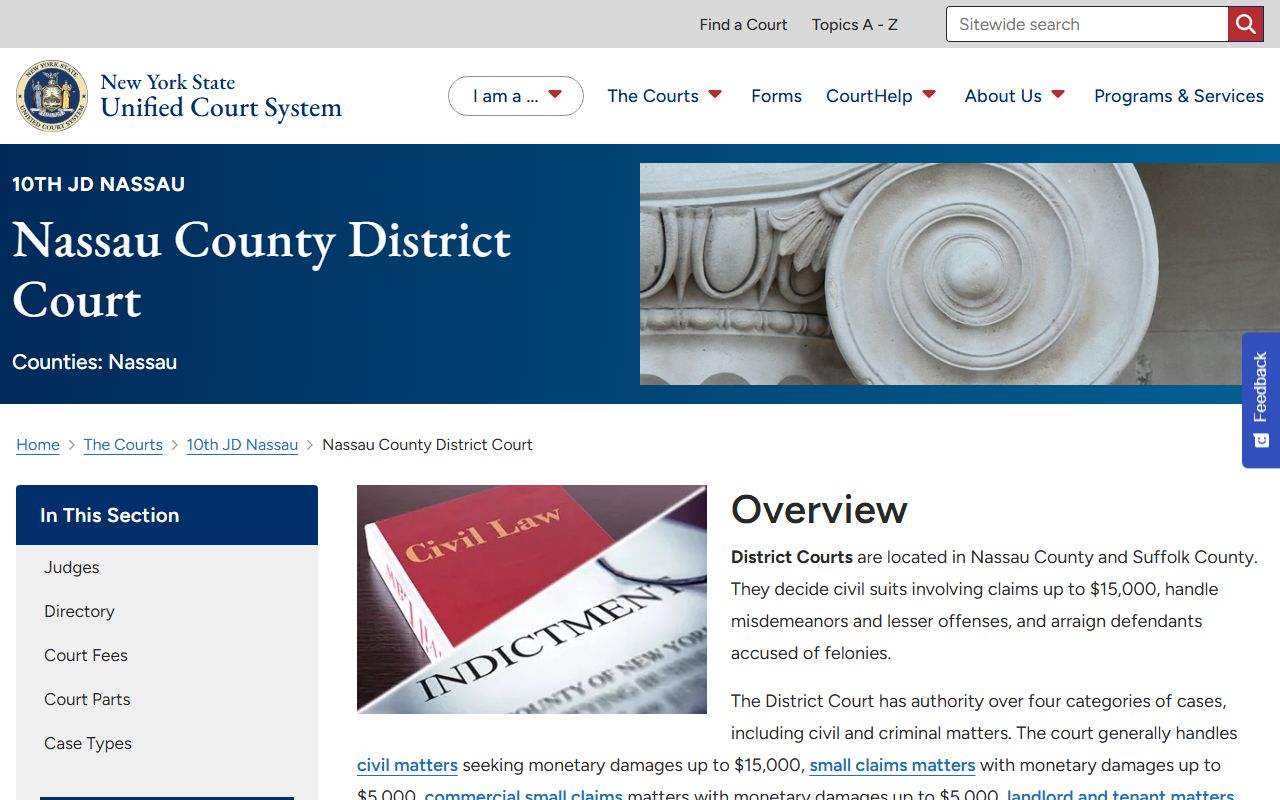
The overview lists jurisdiction, address, hours, and the chief clerk contact, making it the right first stop before a visit or a call.
What Nassau District Court Handles
District Court covers a broad lower docket. Its jurisdiction is set by case type and dollar amount on the civil side, and by offense level on the criminal side. The list below breaks down the main categories.
- Civil claims - Suits up to $15,000.
- Small claims - Small and commercial small claims up to $5,000.
- Landlord-tenant - Housing and eviction proceedings.
- Criminal - Misdemeanors, violations, and infractions.
- Felony arraignments - First appearances before a case moves to County Court.
- Traffic crimes - Tickets that charge a crime, not simple parking matters.
The image below opens the official case-type detail page, which explains the civil, criminal, landlord-tenant, and small claims categories.
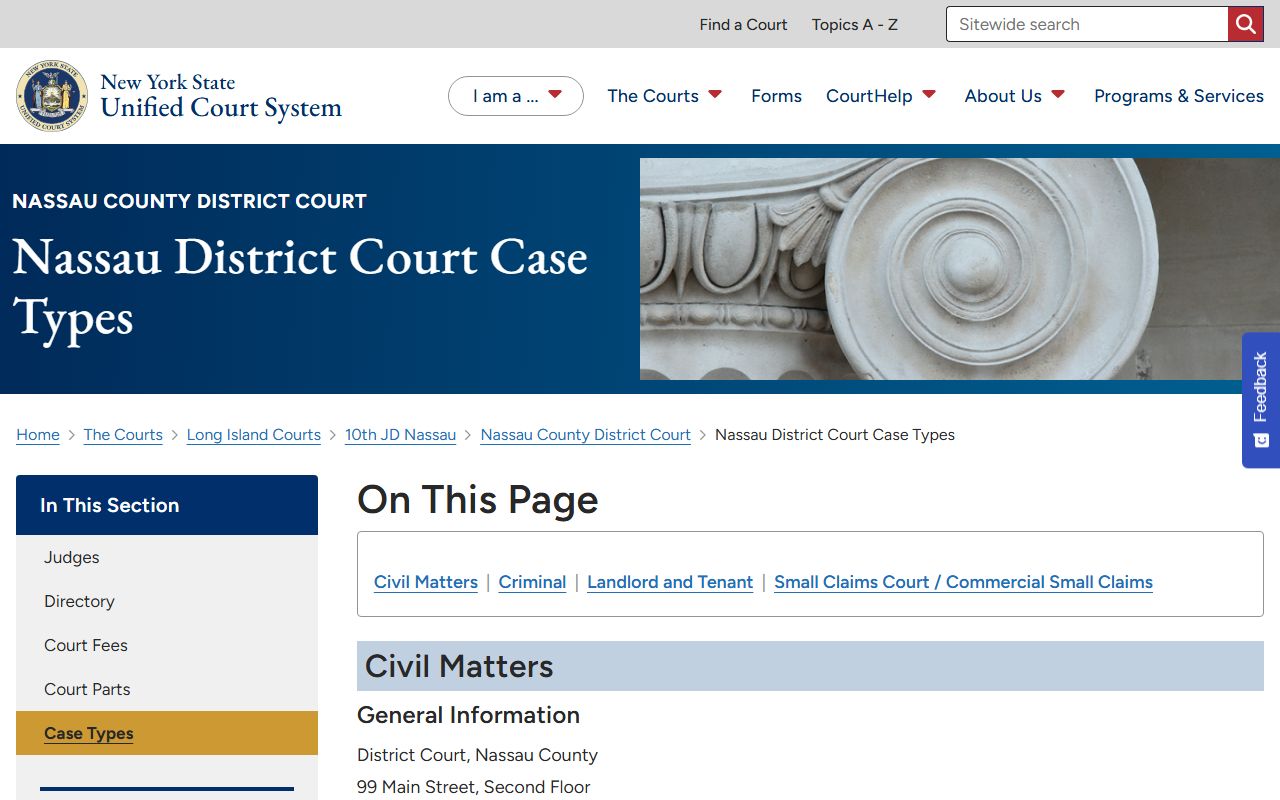
Traffic tickets that do not charge a crime, plus driver-record questions, are covered on the traffic court records page.
District Court vs. County Court vs. City Court
Knowing which Nassau court hears a case saves time. District Court is the lower trial court, County Court handles felonies, and the city courts cover local matters in Long Beach and Glen Cove. The comparison below sorts them out.
| District Court | County Court | City Courts | |
|---|---|---|---|
| Civil | Up to $15,000 | Limited civil | Local civil matters |
| Criminal | Misdemeanors, arraignments | Felonies | Local criminal matters |
| Location | Hempstead | Mineola | Long Beach, Glen Cove |
For the higher courts and the full hierarchy, see the Supreme Court page, which lays out where each Nassau court fits.
How a Nassau District Court Case Moves
A District Court matter follows a quick, calendar-driven path. A civil case opens with a filing, gets a calendar date, and is called at 9:30 a.m. on the date. A criminal case begins at arraignment, where charges are read and release is set, then moves to conferences and disposition.
Filing or arrest → calendar date or arraignment → conferences → trial or plea → judgment or disposition.
One rule trips up many parties. An adjournment request must be in writing. The court will not move a date by phone, and the other side must be told. The image below opens the court parts page, which covers calendar call, adjournment rules, and links to WebCivil Local and WebCriminal.
Missing a date without a written adjournment can lead to a default in a civil case or a bench warrant in a criminal one.
Civil, Criminal, and Landlord-Tenant Parts
District Court splits into departments that each handle a slice of the docket. The civil department takes money claims up to the limit. Small claims runs a simpler, lower-cost track for disputes up to $5,000. Landlord-tenant handles housing and eviction matters, and the criminal side splits into Criminal North and Criminal South.
A treatment court part handles substance-use cases through judicial monitoring, which can route eligible defendants toward services rather than jail. Interpreters are available through a dedicated line, and the small-claims and landlord-tenant pages link self-help guides and forms for people without a lawyer. The certificate of disposition, the certified outcome of a criminal case, costs $5 from District Court.
Filing a Small Claim in Nassau District Court
Small claims is the part most residents use without a lawyer. It is a simpler, lower-cost track for money disputes up to $5,000, with plain forms and an evening calendar in many courts. The District Court small-claims pages link a guide and forms for self-represented people. The steps below outline the common path.
- Confirm the claim is for money only and within the $5,000 limit.
- Get the defendant's correct legal name and address.
- File the small-claims form with the District Court small-claims clerk and pay the filing fee.
- Appear on the assigned date and bring evidence, such as receipts, photos, and contracts.
- If you need an interpreter, ask the court ahead of time through the interpreters line.
Commercial small claims follow a similar track for businesses. Forms and guides are linked from the official District Court case-type pages.
Landlord-Tenant Cases in Nassau District Court
Housing matters are a large share of the District Court docket. The landlord-tenant part handles eviction proceedings, nonpayment cases, and related housing disputes. The state publishes landlord-tenant forms and do-it-yourself tools that the court links for tenants and landlords alike.
These cases move on the same calendar rules as the rest of District Court. Business starts by 4:30 p.m., the calendar is called at 9:30 a.m., and an adjournment must be requested in writing. The landlord-tenant department line is 516-493-4138.
Nassau District Court Department Directory
With so many departments, calling the right desk first matters. The table below lists the department phone directory. The image after it opens the official directory page.
| Department | Phone |
|---|---|
| Main Information Line | 516-493-4200 |
| Chief Clerk's Office | 516-493-4162 |
| Civil Department | 516-493-4113 |
| Criminal North | 516-493-4045 |
| Criminal South | 516-493-4201 |
| Landlord / Tenant | 516-493-4138 |
| Small Claims | 516-493-4125 |
| Arbitration | 516-493-4135 |
| Interpreters | 516-493-4230 |
| Treatment Court | 516-493-4145 |
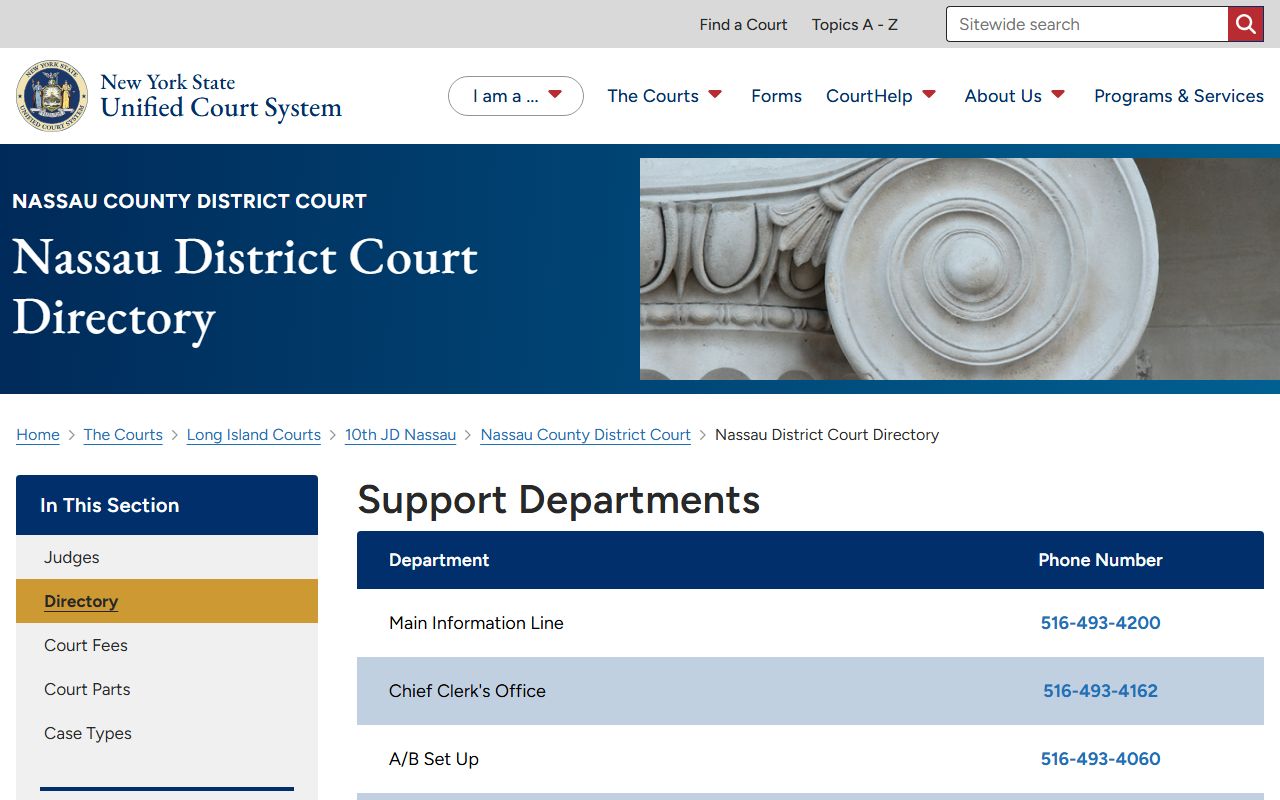
The directory page lists more departments than the table above, including accounting, microfilm, court reporters, and arbitration. Calling the right department first avoids a long hold on the main line.
Searching District Court Records
District Court records are searched through state tools and the court clerk. Civil and landlord-tenant matters use WebCivil Local, linked from the court case-type page. Criminal and traffic-crime matters with a future date may appear in WebCriminal. For certified copies or older files, the District Court clerk holds the record.
Public access still has limits. Sealed criminal cases do not appear in the public tools, and a clean search does not always mean no case ever existed. The rules on sealing and confidential records are covered on the arrest records page.
For a step-by-step on the state portals, see the court records page. For the clerk contacts and certificate requests, see the Court Clerks page.